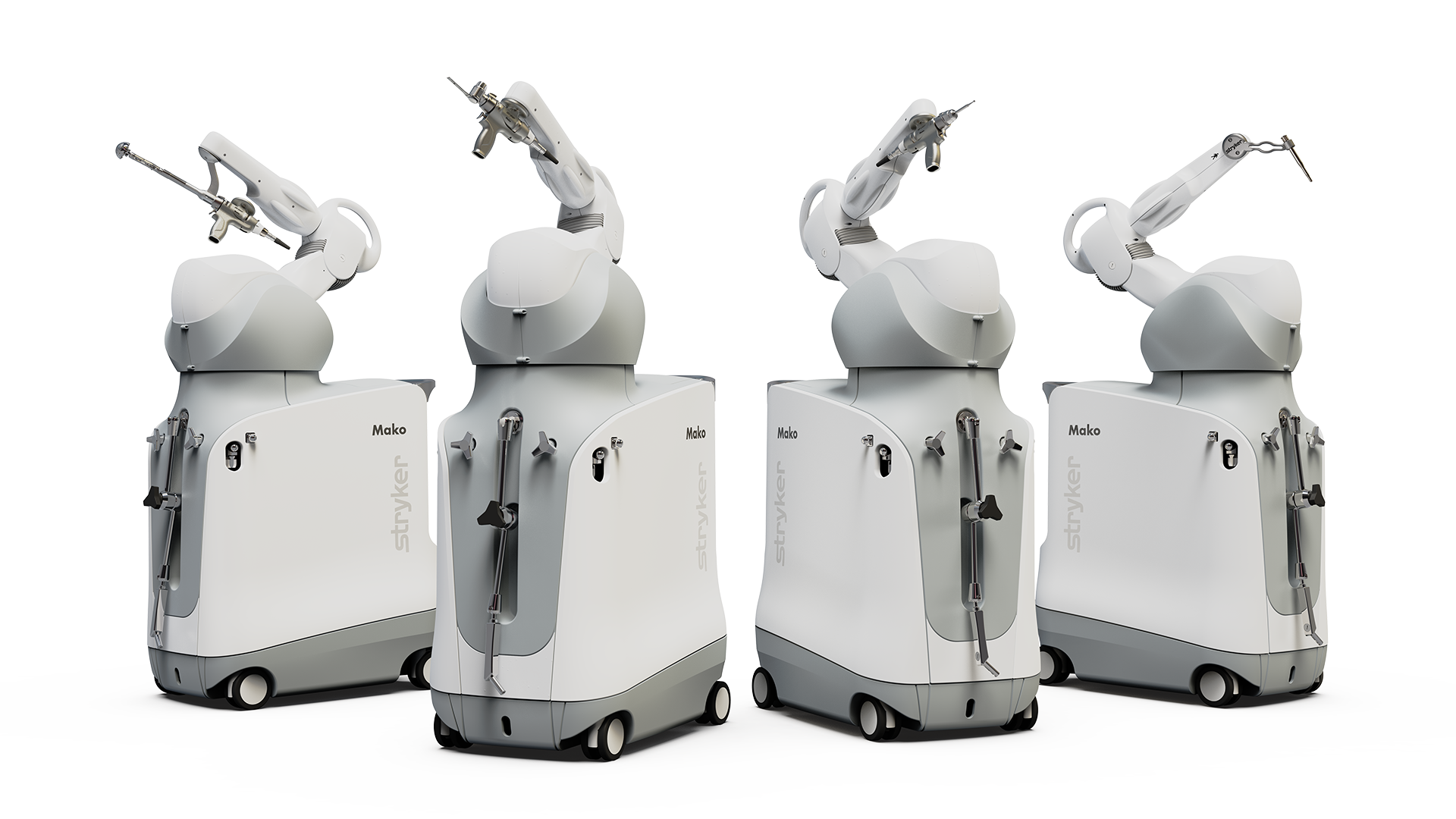
Mako SmartRobotics™ Hip and Knee Procedures
Mako SmartRobotics™ uses robotic-arm-assisted technology to help your surgeon plan and perform hip and knee replacement procedures with a high level of precision. The goal is to help relieve joint pain, restore mobility and support your return to the activities you enjoy.
If chronic knee or hip pain is making everyday activities more difficult, a Mako SmartRobotics™ procedure may be an option for you. To learn more or schedule a consultation with Orthopedics & Surgical Specialists, call (307) 635-2562.
Potential Benefits of Mako SmartRobotics™
Depending on your procedure and individual condition, potential benefits of Mako-assisted hip or knee replacement may include:
- Faster recovery and return to everyday activities
- A shorter hospital stay
- A more natural-feeling knee or hip
- A smaller incision
About Mako SmartRobotics™ Joint Replacement
Every patient — and every joint — is different. Understanding what is causing your knee or hip pain is an important first step in finding the treatment that is right for you.
Arthritis and joint degeneration can cause pain that is constant or comes and goes. You may notice pain with movement, after sitting or resting, or in one or several areas around the joint.
Many people start with nonsurgical treatments such as medication, physical therapy or other conservative options. If these treatments are no longer providing enough relief, your orthopaedic surgeon may discuss whether Mako Total Knee, Partial Knee or Total Hip Replacement could be an option.
Mako technology helps your surgeon create a personalized surgical plan and may provide benefits such as less pain and a shorter recovery compared with manual joint replacement surgery.¹⁻³ Your care team can explain what you may be able to expect based on your individual health and procedure.

Scan. Plan. Mako Can. How Mako Works
Mako combines detailed imaging, personalized planning and robotic-arm-assisted technology to help your surgeon perform your joint replacement procedure.
Scan. Your experience begins with a CT scan of your knee or hip. This gives your surgeon detailed information about the unique shape and structure of your joint.
Plan. Your CT scan is used to create a 3D model of your joint. Your surgeon uses this model to develop a surgical plan personalized to your anatomy.
Mako Can. During surgery, your surgeon uses the personalized plan as a guide while preparing your joint and positioning the implant. Your surgeon controls Mako’s robotic arm, while AccuStop™ technology helps keep the procedure within the planned boundaries.
It is important to know that Mako does not perform surgery on its own. Your surgeon is in control throughout the procedure and guides the robotic arm. Your surgeon can also make adjustments to your surgical plan during the procedure when needed.
Total Knee vs. Partial Knee Replacement
If arthritis in your knee is causing pain and making everyday activities more difficult, your surgeon may recommend either a total or partial knee replacement. The right option depends on how much of your knee is affected by arthritis.
With both procedures, your orthopaedic surgeon uses Mako robotic-arm technology to help remove damaged bone and cartilage and prepare the knee for implant placement.
Mako Partial Knee Replacement may be an option for adults with early- to mid-stage osteoarthritis (OA) that affects only part of the knee. Depending on where the arthritis is located, your surgeon may replace the damaged portion of the knee in one of the following areas: biocompartmental, medial (inside), patellofemoral (top) or lateral (outside).
Mako Total Knee Replacement may be an option for adults with mid- to late-stage osteoarthritis that affects more of the knee. During a total knee replacement, the damaged knee joint is replaced with a Triathlon Total Knee implant.
Triathlon knee replacements have more than a decade of clinical history. Unlike some traditional knee replacement designs, the Triathlon implant is designed to work with the body and support a more natural, circular motion.⁴⁻⁶
Mako Total Hip Replacement
Mako Total Hip Replacement may be an option for people with joint damage caused by degenerative joint disease (DJD). This includes conditions such as osteoarthritis, post-traumatic arthritis, rheumatoid arthritis, avascular necrosis (AVN) and hip dysplasia.
Your surgeon will talk with you about whether Mako-assisted joint replacement may be right for you, including the possible risks and other treatment options available. Your care team will also give you instructions on how to prepare for surgery and what to expect during recovery.
As a total hip arthroplasty procedure, Mako is typically covered by insurance (check with your health insurer ahead of time).
Important Safety Information
As with any surgery, there are potential risks and complications, and results can vary from patient to patient. Your orthopaedic surgeon will review your condition, discuss the risks and benefits of Mako-assisted surgery and other treatment options, and help determine the best approach for you.
References:
1. Kayani B, Konan S, Tahmassebi J, Rowan F, Haddad F. An assessment of early functional rehabilitation and hospital discharge in conventional versus robotic-arm assisted unicompartmental knee arthroplasty: A PROSPECTIVE COHORT STUDY Bone Joint J 2019;101-B:24–33
2. B. Kayani, S. Konan, J. Tahmassebi, J. R. T. Pietrzak, F. S. Haddad Robotic-arm assisted total knee arthroplasty is associated with improved early functional recovery and reduced time to hospital discharge compared with conventional jig-based total knee arthroplasty: A PROSPECTIVE COHORT STUDY Bone and Joint Journal: 2018; 100-B:930–7.
3. Shibanuma N, Ishida K, Matsumoto T, et al. Early postoperative clinical recovery of robotic arm-assisted vs. image-based navigated Total hip Arthroplasty. BMC Musculoskelet Disord. 2021;22(1):314.
4. Piazza S. Designed to maintain collateral ligament stability throughout the range of motion. Stryker-Initiated Dynamic Computer Simulations of Passive ROM and Oxford Rig Test. 2003.
5. Wang H, Simpson KJ, Ferrara MS, Chamnongkich S, Kinsey T, Mahoney OM. Biomechanical differences exhibited during sit-to-stand between total knee arthroplasty designs of varying radii. J Arthroplasty. 2006;21(8):1193-1199. doi:10.1016/j.arth.2006.02.172
6. Gómez-Barrena E, Fernandez-García C, Fernandez-Bravo A, Cutillas-Ruiz R, Bermejo-Fernandez G. Functional performance with a single-radius femoral design total knee arthroplasty. Clin Orthop Relat Res. 2010;468(5):1214-1220. doi:10.1007/s11999-009-1190-2
JR-MKOSYM-OTHW-747688
Copyright © 2023 Stryker